Multimodal Interaction Trends That Feel Human
Multimodal interaction trends are making AI more visual, conversational, and personal. See what changes next for memory, privacy, and everyday help, too.
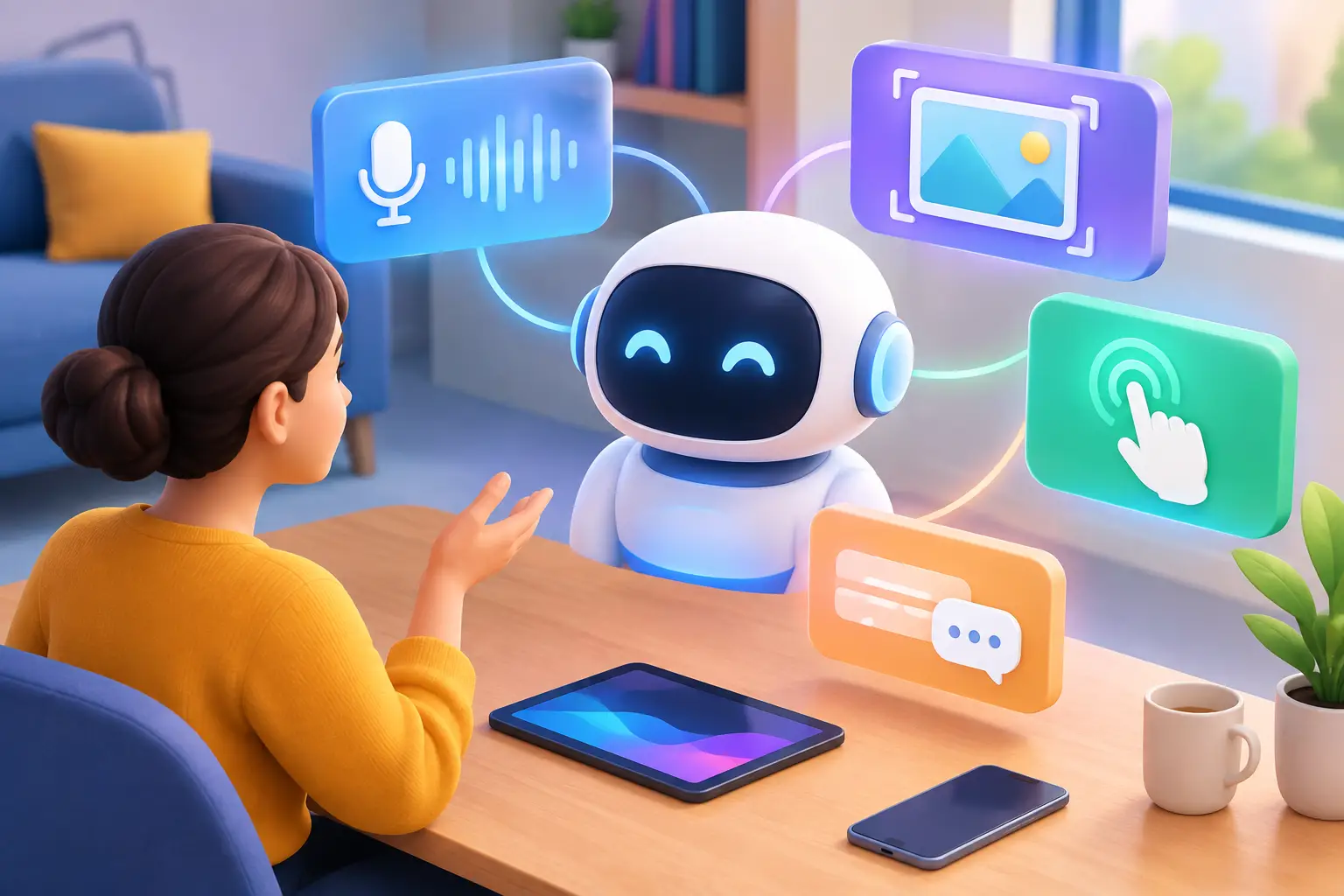
A typed prompt can be useful, but it often asks people to flatten a real situation into a few carefully chosen words. Multimodal interaction trends are changing that expectation. Instead of explaining what is in front of you, you can show it. Instead of composing a question, you can ask it aloud. Instead of restarting every conversation, you can continue from useful context.
That shift matters because most human communication has never been text-only. We speak, point, look, pause, share documents, and refer back to things discussed earlier. AI is beginning to work more like that - not by replacing every interface with a conversation, but by giving people more natural ways to choose the right input for the moment.
Multimodal interaction trends are moving beyond the prompt
Multimodal AI can work with more than one type of information, such as text, speech, images, video, and live camera input. The practical value is not simply that an assistant can accept several formats. It is that these formats can work together to reduce effort and improve context.
Consider someone assembling furniture. A text-only assistant requires a description of the instruction sheet, the unclear step, and the part causing trouble. A visual assistant can examine the page or object being shown, while a voice conversation lets the person ask follow-up questions with their hands occupied. The interaction becomes less about translating the situation for AI and more about getting help within the situation itself.
The strongest trend is not one input replacing another. It is flexibility. Text remains useful for precise requests, code, notes, and situations where silence matters. Voice is often better for quick questions or an extended back-and-forth. Visual input is especially useful when the answer depends on what someone is seeing. People will increasingly move among these modes without treating each one as a separate product experience.
Voice is becoming conversational, not command-based
For years, voice assistants were built around short commands: set a timer, play music, call a contact. Those tasks still matter, but expectations are expanding. People now want to ask a question naturally, clarify what they mean, change direction, and receive an answer that accounts for the ongoing discussion.
This creates a higher standard than speech recognition. A useful voice interaction should handle interruptions, conversational phrasing, and follow-up questions without making the user repeat every detail. If someone asks, “What does this label mean?” after showing a product, the assistant should understand what “this” refers to. If they then ask whether it is suitable for a specific use, the conversation should retain the relevant context.
Voice also introduces trade-offs. Speaking is not always appropriate in an office, classroom, shared home, or public space. Accents, background noise, and unclear audio can affect results. Good multimodal design gives people an easy way to switch to text or combine the two, rather than assuming voice is always the preferred interface.
The best voice experiences leave room for user control
Natural conversation should not mean an assistant talks too much or acts before being asked. Many people want concise spoken answers, a visible transcript, and a clear way to correct or redirect the conversation. Others may prefer a more companion-like exchange. The important trend is adjustable interaction: users should be able to decide how present, detailed, and personal the AI feels.
Visual understanding is becoming an everyday utility
The camera is quickly becoming one of the most practical ways to interact with AI. It can help people understand a form, identify a confusing setting in an app, interpret a chart, review an object, or get guidance while looking at their surroundings.
The key word is context. An image alone may show what something looks like, but a useful assistant needs to connect that image to the person’s goal. A student might show a worksheet and ask for an explanation of a concept. A traveler might point their camera at a transit display and ask what a notice means. A developer might share an interface screenshot and ask why a layout appears broken. Each request combines visual information with intent.
Live camera input can make this even more immediate. Rather than taking, uploading, and describing a photo, a person can show what they are looking at and talk through the question. This can feel more direct, especially for practical tasks where the next useful action depends on details that are difficult to name.
Still, visual AI has limits. Images can be blurry, incomplete, poorly lit, or misleading. An assistant may not see information outside the frame, and it should not present uncertain interpretations as facts. In higher-stakes situations involving health, safety, legal decisions, or financial choices, visual guidance should support human judgment rather than substitute for qualified advice.
Memory is shifting AI from sessions to continuity
One of the most meaningful interaction changes is persistent context. Conventional chat tools often treat each conversation as a fresh start. That can be useful for privacy and one-off questions, but it also creates friction when people want ongoing support.
Contextual memory can help an AI remember preferences, recurring projects, communication style, or details the user chooses to carry forward. For example, someone working on a portfolio may not want to re-explain their goals each time they ask for feedback. A person using an assistant for language practice may value continuity across conversations. In companion-style interactions, memory can make exchanges feel less transactional and more attentive.
But memory only earns trust when it is visible and controllable. Users need to know what is being retained, why it is useful, and how to edit or delete it. Temporary conversations should remain an option. A system that remembers everything by default can feel intrusive; one that remembers nothing can feel repetitive. The right balance depends on the task and the individual.
This is where privacy becomes a product experience, not a footnote. Clear controls, understandable settings, and meaningful deletion options allow people to choose continuity without giving up agency.
Cross-device continuity will matter more than a single interface
People do not live on one screen. They may start a conversation at a desk, continue it while walking, and return to a larger display to review details. As AI becomes more multimodal, continuity across web and mobile devices will become more valuable.
That does not mean every interaction needs to follow a person everywhere. Some tasks are intentionally brief. But for longer projects, learning, planning, or ongoing conversations, the ability to pick up where you left off can remove unnecessary repetition. The assistant should preserve the relevant thread while respecting the boundaries users set around stored history.
The design challenge is knowing what to carry forward. A saved preference may be helpful. An outdated assumption may not be. Good systems will let users review context and correct it, rather than treating memory as permanently authoritative.
Multimodal AI will become more situational
The future of AI interaction is less likely to be one universal interface than a set of natural choices. A person may type a detailed request, switch to voice while cooking, use the camera to show the result, then ask for written next steps. The AI should follow the task rather than force the task into one format.
This makes multimodal interaction especially relevant for everyday assistance. It can support students working through materials, creators reviewing visual ideas, professionals interpreting documents and interfaces, and anyone who wants help with what is happening right now. Visionika reflects this direction by combining live visual input, voice, text, contextual memory, and user-managed conversation history in one continuous experience.
The most promising trend is not AI becoming louder, more animated, or more human-like for its own sake. It is AI becoming easier to involve when a question arises - with the ability to show, say, type, and continue in the way that feels right to you.