How to Identify Plants Visually in the Wild
Learn how to identify plants visually by reading leaves, stems, flowers, bark, and habitat, then use visual AI wisely to confirm what you find outdoors.
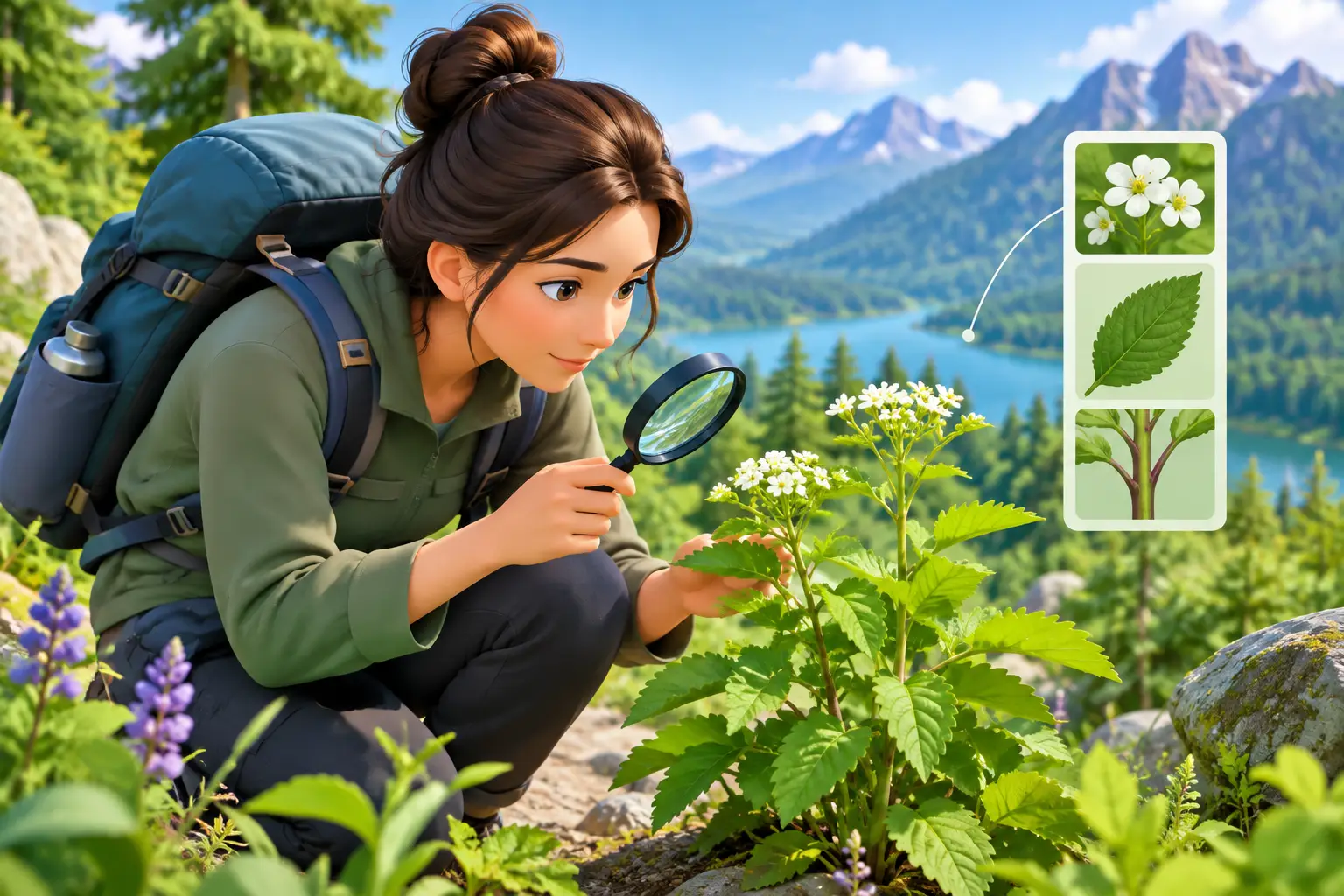
A leaf can look obvious until you compare it with three nearly identical leaves growing a few feet away. That is why learning how to identify plants visually is less about memorizing names and more about noticing a pattern of evidence: the leaf shape, the way leaves meet the stem, the flower structure, the bark, and the place where the plant is growing.
A useful visual identification does not begin with, “What plant is this?” It begins with, “What can I clearly see?” That small shift makes walks, gardens, hikes, and even houseplant care more observant and more accurate.
Start With the Plant’s Overall Form
Before moving close, take in the whole plant. Is it a tree, shrub, vine, grass, fern, succulent, or herbaceous flowering plant? Is it upright, trailing, climbing, clumping, or spreading across the ground?
Size matters, but treat it as a clue rather than a final answer. A young oak and a mature oak do not share the same silhouette. A plant growing in deep shade may be taller and thinner than the same species in full sun. Still, overall form quickly rules out many possibilities.
Look at where the visible parts originate. Woody branches that persist year-round point you in a different direction from soft green stems that die back after a growing season. A basal rosette, where leaves emerge in a circle near the ground, is also a valuable visual feature. Dandelions, plantains, and many garden perennials may share this growth pattern, so you will need more clues, but it narrows the field.
Read Leaves Like a Set of Clues
Leaves are often the fastest route to a likely identification, but one leaf alone is rarely enough. Examine several mature, healthy leaves from the same plant. New growth can have a different color or shape, while damaged leaves can hide the features that matter.
Shape, edges, and veins
Start with the leaf blade. Is it oval, heart-shaped, lance-shaped, round, triangular, needle-like, or divided into distinct lobes? Then look at the margin, or edge. It may be smooth, toothed, scalloped, wavy, or deeply cut.
Veins add another useful layer. Many broadleaf plants have one central midrib with smaller veins branching outward. Others have several strong veins running roughly parallel from base to tip. Some have palmate veins that spread from one point like fingers from a hand. These details can distinguish plants that have a similar outline at first glance.
Leaf texture is easy to overlook. Notice whether the surface is glossy, waxy, fuzzy, leathery, papery, or rough. Turn the leaf over as well. The underside may be lighter, hairy, silver-toned, or marked with prominent veins.
How leaves attach to the stem
Next, check the arrangement. Do leaves grow one at a time, alternating up the stem? Do two leaves emerge directly opposite each other? Or do three or more form a whorl around the stem?
This is one of the most reliable visual clues because it is usually consistent throughout the plant. Maple leaves, for example, grow opposite one another, while oak leaves typically alternate. That observation will not identify every species, but it can prevent a common mix-up.
Also ask whether each leaf is simple or compound. A simple leaf has one blade, even if it has deep lobes. A compound leaf is divided into separate leaflets along a central stalk or from a single point. Poison ivy’s familiar “leaves of three” are leaflets on one compound leaf, a distinction worth understanding for both safety and accuracy.
Use Flowers, Fruit, and Seeds Carefully
Flowers can make plant identification feel easy because color catches the eye. Yet color is often the least dependable feature. Light, age, weather, and natural variation can make the same flower appear white, pink, purple, or blue.
Instead, look at structure. Count the petals if possible. Are they fused into a tube, arranged like a daisy, shaped like a pea flower, or held in a cluster? Notice whether flowers sit singly, in a flat-topped group, in a spike, or in a hanging cluster. The arrangement can be as informative as the bloom itself.
Fruit and seed structures can be even more distinctive. Look for berries, pods, cones, winged seeds, capsules, nuts, or fluffy seed heads. Observe their position on the plant and whether they are smooth, spiny, segmented, or covered in a husk.
Do not taste a berry, chew a leaf, or collect an unknown seed to investigate it. Visual identification is a great starting point, but it is not permission to eat, brew, or handle a plant. Some toxic plants closely resemble edible species, especially before flowering or fruiting.
Notice Stems, Bark, and Other Small Signals
Stems carry clues that are easy to miss when attention stays on the leaves. They may be round, square, ridged, hollow, hairy, thorny, or covered in a powdery bloom. Many members of the mint family have square stems and aromatic leaves, but scent and stem shape should support, not replace, a broader identification.
For trees and shrubs, examine bark from a respectful distance. Is it smooth, peeling, deeply furrowed, plated, striped, or mottled? Bark changes with age, so compare it with twig buds, leaf scars, fruit, and branching pattern whenever you can.
Seasonal changes matter here. In winter, leaves and flowers may be absent, leaving bark, buds, twigs, and the shape of the crown as your best evidence. In late summer, fruit may solve a mystery that spring foliage could not.
Let Habitat Narrow the Possibilities
A plant’s location is part of its visual profile. Note whether it is growing in a dry roadside, wetland edge, forest understory, open lawn, rocky slope, coastal dune, or indoor pot. Pay attention to sun exposure, soil moisture, elevation, and whether the plant seems cultivated or wild.
Habitat never proves an identification by itself. Garden escapes, invasive species, and changing climates all complicate the picture. But a plant found growing beside a stream belongs to a different shortlist than one thriving in hot, dry gravel.
If you are identifying a houseplant, environmental context is still useful. Is it trailing from a hanging pot, forming a stiff upright clump, or growing from a bulb-like base? Are the leaves reacting to low light, dry air, or overwatering? Visual identification and care advice often depend on the same observations.
How to Identify Plants Visually With a Better Photo
When you use a camera or visual AI, the quality of what you show matters more than having the newest device. One distant image of a green plant against green grass gives any tool very little to work with.
Take a small set of clear images instead: the entire plant in its surroundings, a close view of a leaf front and underside, the stem and leaf attachment, and any flowers, fruit, buds, or bark. Include an object for scale when it helps, such as your hand held beside the plant without covering key details.
Then ask a focused question. Rather than only asking for a name, ask what features support the identification, what look-alikes are possible, and which extra photo would reduce uncertainty. This makes the interaction more useful and helps you learn the visual language of plants over time.
A multimodal companion such as Visionika can be especially helpful when you can show what you are seeing and ask follow-up questions naturally. You might point your camera at a leaf, ask about its opposite arrangement, then continue with a closer view of the flower. The goal is not to hand your observation over to a tool, but to use the conversation to sharpen it.
Know When “Probably” Is the Right Answer
Plant identification is often probabilistic. A confident-looking result can still be wrong if the image misses a key feature, the plant is immature, or several related species overlap in appearance. Hybrids and cultivated varieties make this even harder.
Treat an initial result as a hypothesis. Compare at least three independent features before accepting it: perhaps leaf arrangement, flower structure, and habitat. If the plant could be poisonous, irritating, protected, or invasive, seek confirmation from a qualified local source before touching, removing, or consuming it.
The most valuable habit is not memorizing hundreds of species. It is learning to pause, observe from several angles, and remain comfortable with uncertainty. Each careful look turns an ordinary patch of green into a conversation full of evidence.