The Difference Between AI Voices and Chatbots
Learn the difference between AI voices and chatbots, from speech and conversation to vision, memory, privacy, and choosing the right experience for you.
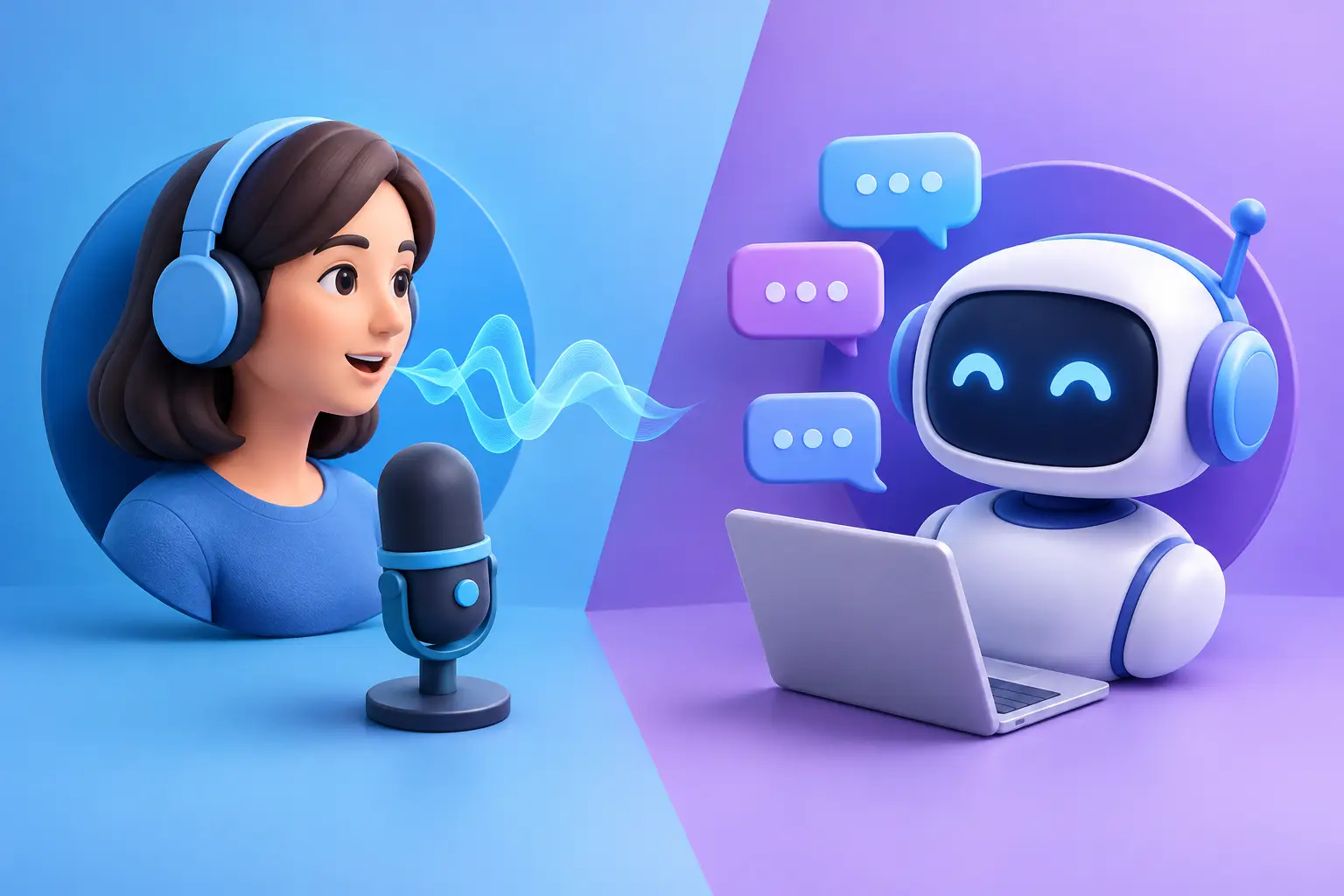
You ask an app to explain a confusing letter, and it answers aloud. Is that an AI voice or a chatbot? The difference between AI voices and chatbots is easy to miss because many modern AI experiences combine both. One is often about how AI communicates with you. The other is about how it holds a conversation and helps you complete a task.
What is the difference between AI voices and chatbots?
An AI voice is usually the speaking and listening layer of an AI experience. It may convert your speech into text, understand your spoken request, and respond in a synthetic voice. It can sound warm, expressive, fast, calm, or highly realistic. But a voice alone does not necessarily make decisions, remember context, or carry on a useful conversation.
A chatbot is an interface or system designed for conversation. Traditionally, chatbots appeared as text boxes where users typed questions and received written replies. More capable chatbots can explain ideas, draft messages, answer questions, analyze information, and guide users through multi-step tasks.
The simplest distinction is this: an AI voice gives an AI a way to hear and speak, while a chatbot gives the AI a conversational format for responding. In practice, those roles increasingly overlap. A chatbot can speak, and a voice assistant can have a full conversation.
AI voices focus on spoken interaction
AI voice technology has two common jobs. Speech recognition turns what you say into text or instructions the system can process. Text-to-speech turns an AI-generated response into spoken audio.
This can be useful even when no real conversation is involved. For example, an AI voice can narrate an article, read directions aloud, provide accessibility support, generate a voiceover, or announce a reminder. In those cases, the voice is primarily a delivery method.
The quality of an AI voice matters because speech carries more than words. Pace, pauses, emphasis, and tone affect whether an answer feels clear and comfortable to follow. Still, a natural-sounding voice should not be confused with deep understanding. A polished voice can deliver a basic scripted response just as easily as it can speak the output of a sophisticated AI model.
Chatbots focus on dialogue and assistance
A chatbot is built around an exchange: you ask, it replies, then it uses the next message to continue the interaction. The better systems can keep track of the immediate topic, ask clarifying questions when needed, and adjust their answers based on your goal.
For instance, a text chatbot may help you compare two job offers. It can explain unfamiliar terms, help you list questions for an employer, and revise a follow-up email. Its value comes from the reasoning and conversational continuity behind the reply, not from whether the reply is shown as text or heard as speech.
Some chatbots are narrow and scripted. A customer support bot that routes you to the right department may recognize a few common requests but cannot handle much beyond them. Others use large language models and can discuss a wide range of topics. Neither type must have a voice.
Why the difference between AI voices and chatbots is blurring
The old distinction made sense when voice assistants handled short commands and chatbots lived in text windows. You might ask a voice assistant for the weather, while a chatbot helped you troubleshoot a billing issue.
Now, one AI can listen to a question, respond naturally, retain the thread of the discussion, and switch to text when you need to review details. That makes the experience feel less like issuing commands and more like talking with an assistant.
The overlap does not mean the terms are identical. It means a product can combine several layers: voice input, speech output, conversational intelligence, memory, and sometimes visual understanding. When evaluating an AI tool, it helps to look beyond whether it has a microphone button or a chat window. Ask what it can actually understand and do.
A practical example: asking about what you see
Imagine you are holding a document with unfamiliar instructions. A voice-only system may let you ask a general question, but it cannot know what is on the page unless you describe it. A text chatbot has the same limitation if you only type, “What does this mean?”
A multimodal AI can work differently. You can show it the document through a camera or upload an image, then ask your question aloud or in writing. It can use the visible context to explain a section, point out what information may be missing, or help you turn the instructions into next steps.
This is where the conversation becomes more useful than either voice or chat alone. The voice makes asking convenient. The chatbot-like reasoning makes the response relevant. Visual input provides the missing context.
Visionika is designed around this broader kind of interaction, bringing voice conversation, text, visual understanding, and cross-device continuity into one experience. The goal is not simply to make AI talk, but to make it easier to get help with the things in front of you.
Memory changes the experience, but it requires care
Another point of confusion is memory. People often assume a voice assistant remembers everything they have said because it sounds conversational. That is not always true. Many voice interactions are treated as isolated requests, while many chatbots only remember what appears in the current conversation.
Persistent memory can make an AI feel more continuous. It may remember that you are preparing for a certification exam, prefer concise explanations, or were comparing options last week. That can reduce repetition and make follow-up questions easier.
But memory is not automatically better. It depends on the situation and on your comfort level. Personal context should be visible and manageable, especially when conversations include sensitive subjects, images, work materials, or everyday details. A thoughtful AI experience should make it clear what is retained and give users meaningful control to review or delete stored conversation history.
Choosing the right experience for the task
Choose an AI voice when listening and speaking are the main needs. It is helpful when your hands are occupied, when you are walking, cooking, practicing a language, or simply prefer to talk through an idea. Voice can also make AI more accessible for people who find typing difficult or tiring.
Choose a text chatbot when you need a record you can scan, copy, edit, or refer back to closely. Text is usually better for code, detailed comparisons, structured plans, citations you need to verify, and information with names, numbers, or precise wording.
Choose a voice-enabled conversational AI when you want the ease of speaking without giving up the ability to reason through a topic over several turns. If it can also understand images, documents, screens, or camera input, it may be especially useful for real-world questions that are difficult to describe from memory.
There are trade-offs. Voice is quick, but it can be inconvenient in a quiet office or crowded train. Text is precise, but it can feel slower when you only need a quick answer. Visual AI adds helpful context, but users should consider what they are comfortable sharing and what privacy controls are available.
The better question to ask
Rather than asking whether an app is “a voice AI” or “a chatbot,” ask how naturally it fits into the moment. Can you speak when speaking is easier? Can you read and edit when precision matters? Can it understand the document, object, interface, or image you are looking at? Does it continue a conversation appropriately, while keeping you in control of your history?
The most helpful AI does not force every question into one format. It meets you with the right combination of voice, text, vision, and context, then gives you a clear way to decide what stays remembered and what does not.